
are you vibe coding… or vibe dating?
when gut feelings guide product decisions, are you finding true resonance or just a fleeting connection?
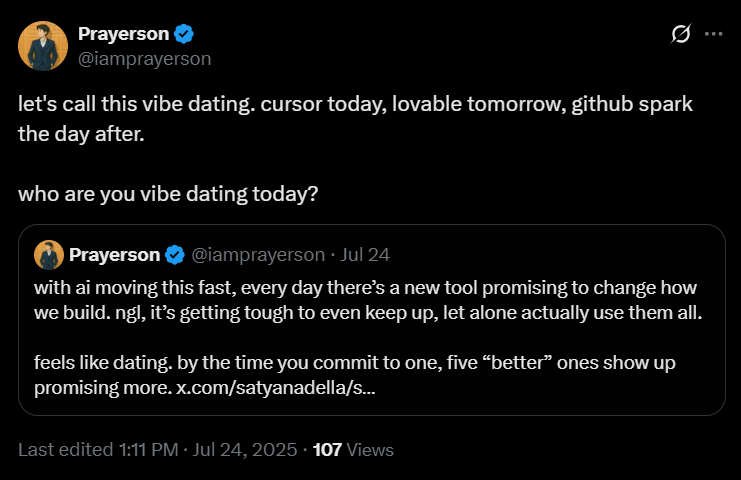
you know how it goes in dating, right? sometimes, it’s not about the checklist, shared hobbies, future plans, all that stuff. it’s just… a vibe. an instant click, an unspoken understanding that feels authentic, effortless. you just get each other. it’s refreshing, almost magical. but i’ve been noticing this same fuzzy feeling creeping into our work lives, especially when we’re picking out ai tools. are we, the folks building things, falling for the quick spark, or are we actually settling down for the long haul? are we "vibe coding" or just "vibe dating" our way through the tech world?
the irresistible pull of the unquantifiable
think about "vibe dating" in real life. it’s so appealing because it skips all the awkward first steps. it’s like a fast pass to intimacy, a hope that pure chemistry can carry you through. in a world where everything’s about data, algorithms, and perfectly curated profiles, trusting your gut feels… human. and yeah, our gut feelings are smart; they’re little supercomputers processing tons of tiny observations in a blink. but here’s the thing: that initial spark, while totally exhilarating, usually isn't enough to run a marathon. a "good vibe" can sometimes hide bigger issues, like not really being on the same page long-term. in the product world, this translates to a sobering reality: studies often show that a significant percentage of new features, sometimes as high as 60-80%, fail to gain significant user adoption or deliver expected value, often because they weren't rigorously validated beyond an initial "good feeling."
now, let’s bring that back to our product and dev world, especially with all these new ai tools popping up every other day. how do we even pick? do we commit to one, or do we just hop around? this is where the whole "vibe coding" versus "vibe dating" thing really hits home.
vibe coding: when your tool becomes your ride-or-die
i started with cursor. honestly, it wasn't because i saw it plastered all over twitter or anything. it was because someone i really trusted just wouldn't shut up about it. so, i figured, why not? i gave it a week. it was… fine. nothing spectacular.
then i gave it two. and suddenly, something clicked. i wasn't googling syntax every five minutes. i was just… building. refactoring felt smoother, almost intuitive. writing tests didn’t suck anymore. cursor wasn’t just some editor with ai slapped on; it felt like a real pair programmer. it got my messy code, held onto context through endless files, and actually kept up with my brain. this kind of deep integration can lead to substantial productivity gains; some reports indicate that developers using advanced ai coding assistants can complete tasks up to 50% faster, particularly for repetitive or boilerplate code.
that’s vibe coding. it's when you really go deep with one ai tool. you learn its little quirks, how it thinks. you adapt to it, and it starts adapting to you. it’s not just about being faster; it’s about being genuinely better because of that partnership. it's the commitment, the long-term relationship where you understand its nuances, predict its moves, and weave it seamlessly into your own unique way of working. that deep understanding is what gives you the kind of efficiency and quality that a quick fling just can’t touch. you're mastering a true collaboration.
vibe dating: the endless swipe for the next big thing
but, as with any honeymoon, this one doesn’t last forever. one weekend, you’re scrolling, and boom – someone drops a tweet: “lovable just hit $100m arr, fastest ever.” naturally, you click. clean ui. claude, gpt, gemini, all in one spot. faster generation. better onboarding. and just like that, the thought pops into your head: should i switch?
that’s vibe dating. you’re still coding, still building, sure. but you’re jumping between tools like you’re on hinge. cursor today. lovable tomorrow. windsurf on friday. gemini next week. it’s whatever feels smartest, coolest, most powerful this hour. and honestly, there’s nothing inherently wrong with that. exploring new things can spark amazing insights. and right now, the tooling space is absolutely on fire: replit added “ghostwriter” context memory; claude 3.5 outperformed gpt-4 in code reasoning; windsurf lets you build with code + canvas; github added spark; openai is soon releasing gpt-5. it’s a dizzying pace, and it’s totally human to want to try out the latest and greatest.
the catch: dopamine vs. actual output
the siren song of "vibe dating" in the tooling world is incredibly strong. it promises constant novelty, the thrill of finding that next, possibly perfect, solution. it’s a little hit of dopamine every time a new feature drops or a benchmark gets shattered. but here’s the real catch: breadth wins dopamine. depth wins output.
while that initial spark is great, constantly hopping tools based on a fleeting "vibe" can lead to some real headaches.
you never truly master anything. every tool, even if they seem similar, has its own unique way of doing things, its own shortcuts, its own internal logic. if you’re always switching, you never really get into the flow with any of them. you stay in perpetual beginner mode, wasting precious time relearning instead of actually building. and that hits your speed and the quality of your work. research suggests that context switching, even between seemingly similar tasks or tools, can reduce productivity by as much as 40%.
your context gets all jumbled. a truly effective ai pair programmer remembers what you’re working on. if you’re jumping around, that context gets broken. the ai doesn't "know" your project inside out, which means less accurate suggestions, more annoying repetitive prompts, and that feeling of a real partnership just fades away. your whole workflow becomes choppy, a bunch of disconnected tasks instead of a smooth, integrated process.
it can lead to shallow decisions. when we pick tools based on quick impressions or what’s trending on social media, instead of really thinking about how they’ll help us long-term, it’s tough to build a truly solid, optimized development setup. this can cause friction within teams, waste money on constant migrations, and make it hard to hold anyone accountable for those tool choices. the cost of software churn, including licensing fees for unused tools and the overhead of constant evaluation and migration, can add up significantly for organizations.
finding true resonance: a balanced approach
so, how do we avoid getting stuck in the "vibe dating" cycle while still keeping up with all the incredible ai advancements? it’s about finding a balance: mixing the art of smart exploration with the science of committed mastery.
treat new tools like experiments, not instant replacements. when that tweet drops about the next "insane" tool, don't just dismiss it. instead, think of it as a hypothesis: "maybe tool x could really make my workflow for task y better." then, set up a small, controlled test. spend a specific, limited amount of time trying it out on something that’s not mission-critical. this turns a vague feeling into something you can actually test, without messing up your main work.
really dig into the data before you commit. if a new tool truly proves itself in your little test, then think about bringing it in, but do it in stages. lean on objective stuff: how much time did it actually save? did it reduce bugs? improve code quality? was the team happier? data gives you the real story that a "vibe" alone can’t. i remember a product manager at a big saas company who swore a new dashboard layout would be super intuitive. however, a/b testing revealed a slight decrease in engagement. the "vibe" was well-meaning, but the data showed the truth. companies that prioritize data-driven product decisions are statistically more likely to achieve higher revenue growth and better customer satisfaction. apply that same rigor to your tools.
build a culture where it’s okay to challenge. encourage your team to question assumptions about tools, even if someone has a really strong initial "vibe" about one. create a space where it’s safe to show data that contradicts that feeling, and where decisions are debated based on evidence of long-term productivity, not just initial excitement. this doesn't mean shutting down creativity or intuition, but rather sharpening it through smart questions and a focus on lasting benefits.
figure out your personal superpower. in a world where the tech stack seems to change every week, your real advantage might just be… picking one thing and going deep. not because it’s the absolute best tool out there. but because mastery beats novelty, every single time. your ability to squeeze every last drop of value from a tool you truly understand, to push its limits, and to make it a seamless extension of your own brain and workflow – that’s a competitive edge that constantly jumping around just can’t give you. deep work, as opposed to shallow work, has been shown to be a key driver of innovation and high-quality output in complex fields like software development.
conclusion
at the end of the day, we’re not trying to kick intuition out of product management. we just need to use it wisely. just like a good relationship needs both that first spark and a whole lot of sustained effort, a successful product workflow needs both an inspiring curiosity and disciplined mastery. by really understanding when we’re just "vibe dating" new tools and when we’re truly "vibe coding" with our chosen companions, we can build products that not only feel right but genuinely serve, scale, and stick around for the long haul, all fueled by a depth of understanding that goes way beyond fleeting trends.