
Design Thinking 101
Design Thinking is an ideology which asserts that a user-centric approach to problem solving leads to innovation in a competitive environment. It comes with an accompanying process that aims to find the intersection between human needs, technological feasibility, and economic success. Design thinking has been practiced for ages. Throughout history, good designers have applied a human-centric creative process to build meaningful solutions. This approach is often taken by companies trying to innovate solutions for real user problems to find a competitive advantage.
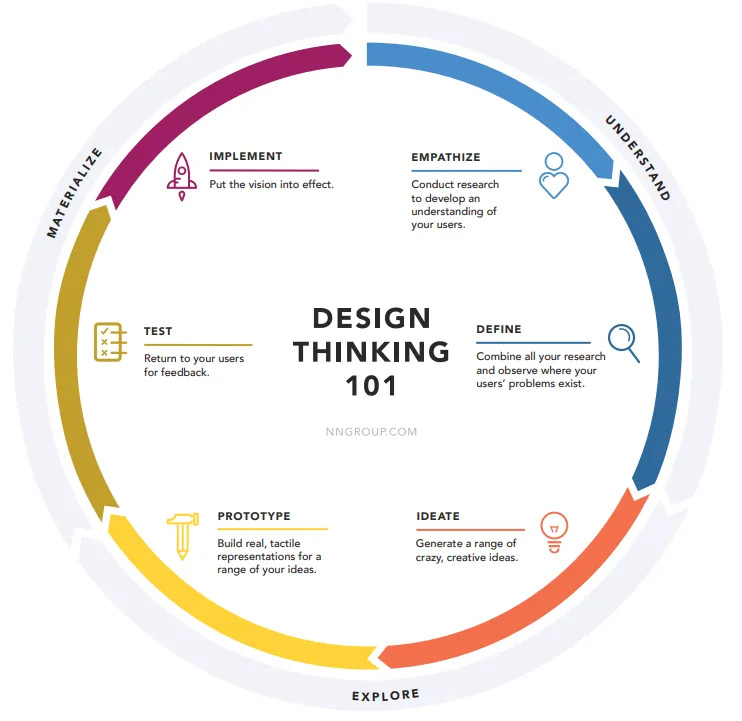
Let’s dive into the six phases of the design thinking process:
Empathize: The goal of this phase is to empathize with users and try to find their real problems. Most of this is achieved by doing 1:1 user interviews or group interviews. The PMs should understand the users first-hand (by doing targeted research) and ask the right questions to effectively gather the pain points of the users.
Define: Once you’ve talked to the users and asked the right questions, the PM will have abundant data from the user interviews to define the real problems and pain points. The PM will have to map each user’s problems to an affinity map and come to a conclusive pain point that can be addressed. Several times, you may identify multiple problems, however, you’ll have to prioritize the problems using relevant framework depending on the impact it’ll deliver.
Ideate: Now that you have narrowed down to major problems and pain points, it’s time for ideation. This is not necessarily for the PM alone; the entire scrum team and representatives from other teams (if required) should do ideation on the solution. The PM should majorly be able to create an inflow of quality ideas and feedback during the brainstorming sessions. The PM should also be able to keep the sessions on track by gathering the ideas that meet the desirability, viability, and feasibility of the incoming ideas. Once you have the ideas, the PM then prioritizes the solution using relevant frameworks.
Prototype: Once you have set the right priorities, it’s time to prototype the solution. This process can be time-consuming as it involves a lot of feedback gathering from internal stakeholders and iterating based on the feedback. The iteration will continue until your prototype has reached a life-like solution to your listed problem and pain point.
Test: Let a specific set of users interact with your protype and comment on how effectively it meets their unmet needs. Gather feedback and iterate if needed.
Implement: This is the most crucial part of design thinking, yet one of the most forgotten. Put your solution into effect. Ensure that the solution touches the lives of your targeted audience. The success of design thinking lies in its ability to transform an aspect of end user’s life.
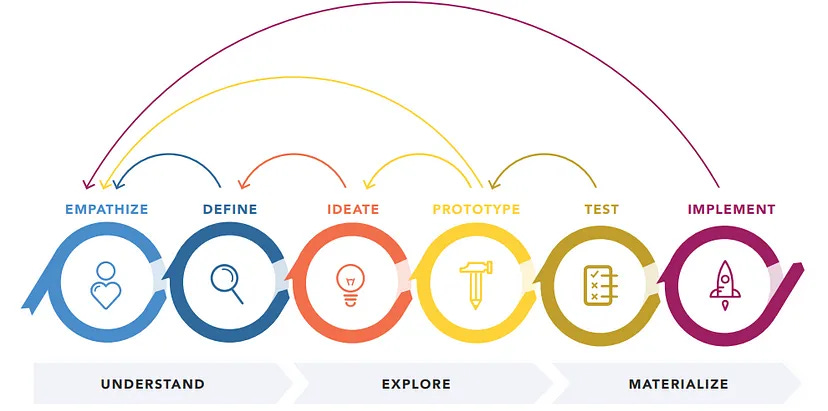
The above-listed method is not supposed to be a step-by-step approach to make a successful product or feature. In fact, each phase is meant to be cyclical and iterative. See below.
“There’s a reason we are called practitioners. It’s a practice.”
- Sarah Gibbons, Nielsen Norman Chief Designer