
the new browser wars are here
why the ai browsers will kill google ad revenue (and your business)
if you’d rather listen than read, check out the latest episode on “the new browser wars are here”.
i. why the ai browser is breaking the web (and how to fix your business)
your business is sitting on an internet that is fundamentally changing. agentic browsing platforms are kicking off the second great browser war, and this is an existential threat to your current economic model.
stop measuring clicks. start measuring completed tasks.
the unit of value is moving from passive information to autonomous task execution. if you don’t rethink your frameworks now, your business risks being left behind.
the battle lines are clear:
ai-native challengers (openai’s chatgpt atlas, perplexity’s comet) are subscription-first and built from scratch to prioritize task automation.
incumbents (google chrome with gemini, microsoft edge with copilot) are playing defense, leveraging enterprise security and user inertia to protect ad revenue, as the google cloud blog details.
the browser is no longer just a window; it’s a workflow operating system. that shift comes with extreme security demands and huge data privacy risks. atlas, for instance, uses keychain access control lists to lock users out of their own local history. control over your data is no longer fully in your hands.
ii. the history of browser wars and why web agents are the future
you are staring down the same risk netscape faced two decades ago. they lost 70% market share chasing “cleaner code,” wiping out hard-won fixes and stability. the lesson: incremental gains can’t outpace user habit and inertia.
today, the new ai browsers face the same trap. if they can’t roll out stable agent features faster than the incumbents add ai to their existing platforms, user laziness will crush them.
the stakes: google ad revenue is under immediate threat.
ai browsers skip the search results page (serp) entirely, delivering completed actions instead of link lists. major publishers are already feeling the pain.
agentic browsing is the next future.
your ai model turns a goal like “book that flight” into a structured plan (think json) and executes it with browser-level commands, mimicking human clicks, scrolling, and form filling. the outcome is a completed action, not a list of links. action replaces the click as the core metric.
iii. meet the competitors: chatgpt atlas vs. perplexity comet
the choice is between personal automation (atlas) and professional synthesis (comet).
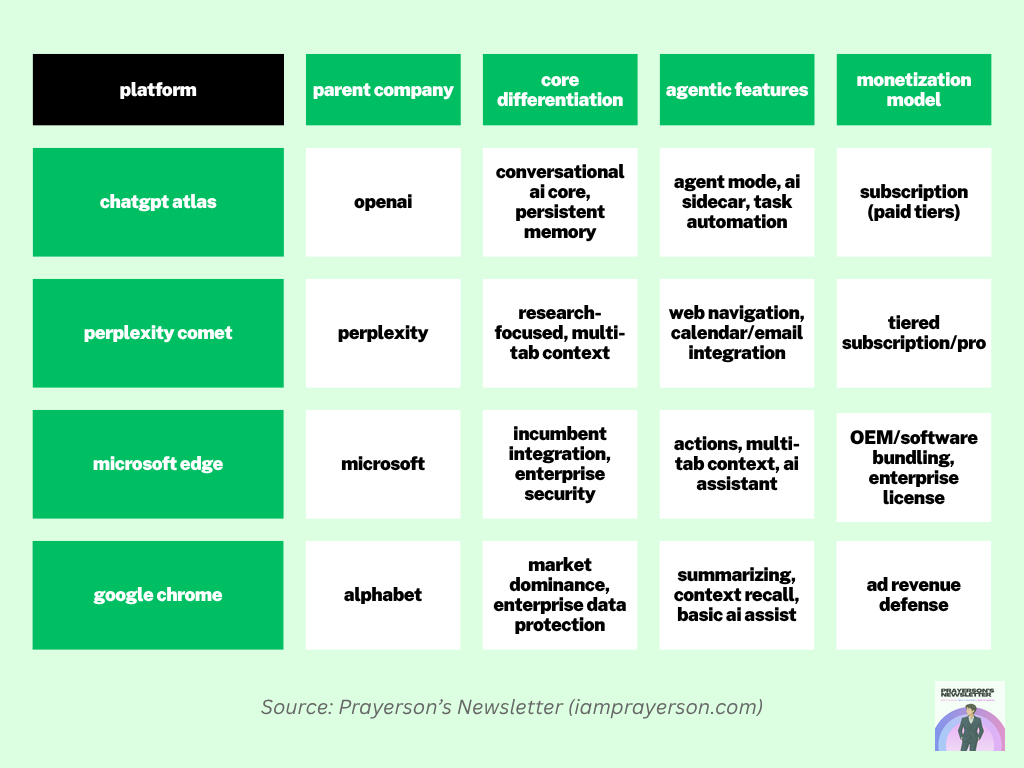
atlas was built from scratch around conversational ai. its persistent memory tracks what you do on sites, creating deeply personalized responses. agent mode automates multi-step tasks. subscription tiers signal that agentic flows are the next monetizable unit.
comet excels at research. its agent manages multi-tab context and professional workflows, targeting high-stakes work like financial analysis. it synthesizes complex datasets into actionable insights.
iv. how google and microsoft are trying to save their ad revenue
both incumbents are playing defense.
google chrome + gemini protects ad revenue via enterprise-grade data controls. gemini is a helper, not a replacement. summaries and context recall are enough to keep users in the ecosystem while safeguarding ads.
microsoft edge + copilot mode is more aggressive. copilot can access open tabs, history, and credentials to execute multi-step tasks. copilot vision adds real-time screen analysis. the goal is ai-driven utility without losing existing enterprise trust.
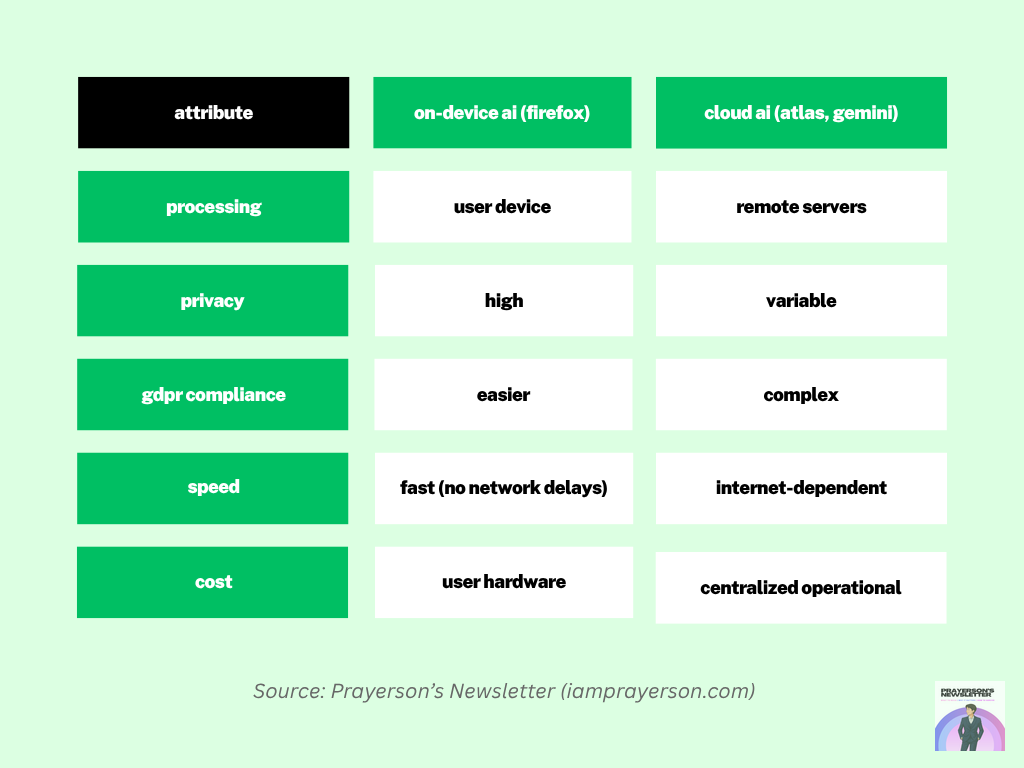
mozilla firefox takes a privacy-first path: on-device ai ensures data never leaves the device. it integrates open-source local models, a governance-compliant alternative for privacy-conscious users.
v. how web agents work: the technical secret
ai browsers execute a plan by translating goals into browser actions: scrolling, clicking, form filling. errors are costly, making governance critical. context-aware policy engines (like langgraph) ensure each action follows security rules, maintains state, and can be audited. without this, autonomy becomes risk, and not utility.
vi. data privacy: why you don’t control your ai browser history
persistent memory powers agents but creates a risk. atlas encrypts local data with system access control, locking users out of exporting or backing up history. the platform gains unilateral control, aka, a structural data lock-in.
ai systems also amplify privacy risks: data repurposing, model training, and surveillance can violate gdpr. deleting or controlling your data becomes challenging when your actions are deeply integrated into the agent memory.
vii. how to monetize agentic browsing
your ad model is dead. the future is utility consumption.
new metrics: agent engagement rate (aer) tracks successful task completion, correlating with loyalty and future revenue.
monetizable units: revenue shifts from ad exposure to agent flow consumption, usage-based billing, and subscription tiers. dynamic licensing controls access to high-value features.
viii. your plan to win: ai optimization (aio) and strategic defense
fail to adapt, and your content disappears from the agent flow. your mandate: ai optimization (aio).
semantic html and schema markup: clean headers, rich metadata, structured data. web agents rely on clarity to execute tasks.
speed and structure: prioritize content for immediate retrieval, with key info at the top.
protocol adherence: manage agent access explicitly (llms.txt, robots.txt). opaque sites get ignored.
finance tip: deploy ai investment agents to analyze 10-k filings, earnings calls, and excel models. scenario simulations and valuation modeling become agent-driven, amplifying your analytical edge.
strategic pathways:
incumbents: protect enterprise trust and proprietary workflows.
challengers: move fast on core utility while solving data export/control issues.
firefox/open-source: champion on-device ai and verifiable privacy as a premium differentiator.
Excellent analysis; it really does feel like we're always fighting new browser wars, now with more AI and less control over our digital lifes.