
your ai is a butler. you need a coworker.
the shift from prompt engineering to agentic design, and why it changes everything.
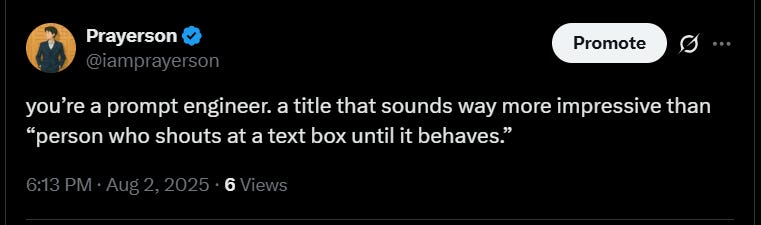
let's talk about that moment. you know, the one where you're a genius, and your genius has a terrible, terrible boss. that boss is you. the genius, of course, is the ai. you're giving it commands like it's a dog: "roll over and write me a quarterly report." it rolls over. "now fetch me some snappy bullet points for the team slack." it fetches. and you, the micromanager, the foreman, the master of this endlessly patient digital butler, feel like you've got it all figured out. you're a "prompt engineer," a title that sounds a lot more impressive than "person who shouts at a text box all day." the problem is, you're not getting a partnership; you’re getting a glorified, text-based secretarial service. it's a workflow built on a series of small, reactive tasks, and as a recent study from the american psychological association found, constantly switching between tasks can reduce productivity by up to 40%. you’re still doing all the thinking, and the ai is just waiting for your next instruction.
but what if you could fire that butler? what if you could hire a coworker instead? someone who not only understood what you wanted but was smart enough to figure out how to get it done on their own? the biggest evolution in ai is its shift from following commands to autonomously completing projects. we're moving from a world where we command our ai to one where we delegate to it. the market is screaming for coworkers, and if we don't start building them, our current "ai genius" is just going to keep doing what it's told, one bland sentence at a time.
the glorified secretary and the tyranny of the user
we’ve spent the last few years mastering the art of the perfect command. we've learned the dark magic of context windows and the voodoo of negative prompts. our lives as builders have become a beautifully choreographed, if slightly absurd, dance of commands:
"create a jira ticket for a new feature."
"now, add three user stories."
"now, define the acceptance criteria for each."
"now, can you also draft a slack announcement about it, but make it friendly?"
"and for the love of all that is holy, please remember to ping the engineering lead."
this is a glorified, text-based micromanagement session. the ai is reactive; it only acts when you tell it to. it's a master of tasks, but not of outcomes. the goal isn’t to write the ticket or the email; the goal is to ship the feature. but the ai has no concept of the ultimate goal. you are the only one holding the entire workflow in your head, constantly context-switching and doing the "work about the work." it’s like hiring a brilliant chef and then having to stand over their shoulder and tell them, "now add a pinch of salt," "now add a dash of pepper," "now can you also wipe down the counter?"
it’s exhausting, and it’s a symptom of a larger problem: we’re still designing for a world where the human is the center of every decision loop, even the most mundane ones. this is profoundly inefficient and a profound waste of the ai's potential. we’re using a ferrari to go to the grocery store. it’s a powerful tool, but we're only using it to perform the most basic of errands.
the coworker arrives: from commands to missions
the real change is happening right now, and it's called agentic ai. this is the coworker; the one who gets it. the one you don't give a task to; you give them a mission. instead of asking, "find me the cheapest flight to paris next month," you could tell an agent, "find the best deal for a team offsite in paris next september, considering flights, hotels, and a budget of $15,000."
the agent, being the autonomous overachiever it is, then breaks down that goal into a series of steps. it might check flight prices from multiple airports, find hotels with conference rooms in your budget, and even create a pre-filled expense report for you to approve. it operates autonomously, making decisions, and correcting course without needing a new prompt for every single step. we are already seeing this in action. in a recent report by digitaldefynd in 2025, agentic ai systems were shown to complete up to 12x more multi-step tasks than standard llms. in a logistics case study, an agentic system reduced planning time from 5 hours to just 35 minutes by taking a high-level goal and executing it independently. the system didn’t just respond to commands; it owned the outcome. it didn’t ask, "should i check for hotels?" it just did it.
the agent is the coworker who not only completes their tasks but also anticipates your needs. it's the new hire who not only builds the feature you asked for but also writes the tests, deploys to staging, and pings you on slack to let you know it's ready for review. this is a new paradigm that completely redefines our jobs.
the product manager's mid-life crisis
so what happens when our faithful butler evolves into a coworker who can do most of the tedious work on their own? your role as a product manager will change from being a foreman of a human team to a ceo of a human-ai team. you won't be managing a scrum board full of tasks for humans anymore. instead, you'll be setting the strategic mission, designing the guardrails, and architecting the workflows for a team of autonomous ai agents. this new job is less about managing people's day-to-day execution and more about ensuring your hyper-competent ai coworkers are moving the product forward within safe, well-defined boundaries.
this requires a new set of skills:
goal definition: you're not just writing prompts; you're writing objectives. you need to be able to articulate a clear, ambitious, and measurable goal that the agent can autonomously pursue. the goal is no longer "summarize this document," it’s "research and synthesize the top 5 market trends for q3." you're defining the why, not the how.
guardrail design: this is the most critical part of your new job. you’re building the safety fences. it's designing the constraints and rules that prevent the agent from making costly or irreversible mistakes. for example, telling an agent to "find the best deal for a team offsite" should come with a crucial guardrail: "do not book any flights or hotels without human approval." this is where you, the human, provide the crucial context that an agent can’t yet grasp, such as "don't book a team offsite during the one week in september when our cfo is on vacation and can’t approve the budget."
feedback loops: you're no longer giving commands; you’re giving feedback. you need to design the system that allows an agent to report its progress, ask for clarification, and receive course corrections. the agent will show you its work, explaining its decisions and asking for input on a crucial fork in the road, such as, "i found two options, one is 15% cheaper but requires a 6 a.m. flight. which is more important: cost or convenience?" this is where you, the human leader, provide the crucial, nuanced judgment that the ai can't.
our new product is the system of governance we build around the ai. the focus moves from what the user types to what the user gets. this redefines what it means to be a product builder, going far beyond a technical shift. it’s the journey from being a micro-manager of a butler to a strategic leader of a team.
the future of work (and our new ai teammate)
the most successful products of the next five years won't be the ones with the most intelligent butlers. they'll be the ones that have figured out how to build the best teams of autonomous agents. the real challenge, and the real opportunity, for product managers is to move beyond the keyboard and start architecting a future where our ai is not just a tool we use, but a partner we trust. it's a future where we spend less time on tedious tasks and more time on high-level strategy. it's a future where the work itself shifts to designing the systems that get things done.
