
why product market fit is getting harder in the ai era
how infinite supply, instant cloning, and ai-native users changed what fit even means
if you’d rather listen, “the pmf paradox” episode is live now.
the pmf paradox nobody is talking about
over the past year, i have sat in a lot of rooms that looked very successful on the outside. companies had users. some had revenue. a few were even growing. yet the mood inside those rooms felt wrong in a way that was hard to articulate. nobody was celebrating or confident. everyone was hedging.
the pattern kept repeating. teams would describe steady signups, decent activation, even some strong use cases, but when the conversation drifted toward the future, it became vague. roadmaps looked nervous, and founders kept asking whether they should pivot. pm’s worried that their product was replaceable, even when metrics looked healthy.
this is the paradox of the ai era:

in the ai era, getting someone to try your product has become trivial. keeping them inside it has become brutally difficult. the paradox is that while distribution has become easier, attachment has become rarer. this gap between initial interest and lasting behavior is where modern pmf breaks down.
we are not in a world where bad products fail and good ones win. we are in a world where many products are good enough, and most of them feel disposable.
the old pmf model and why it used to work
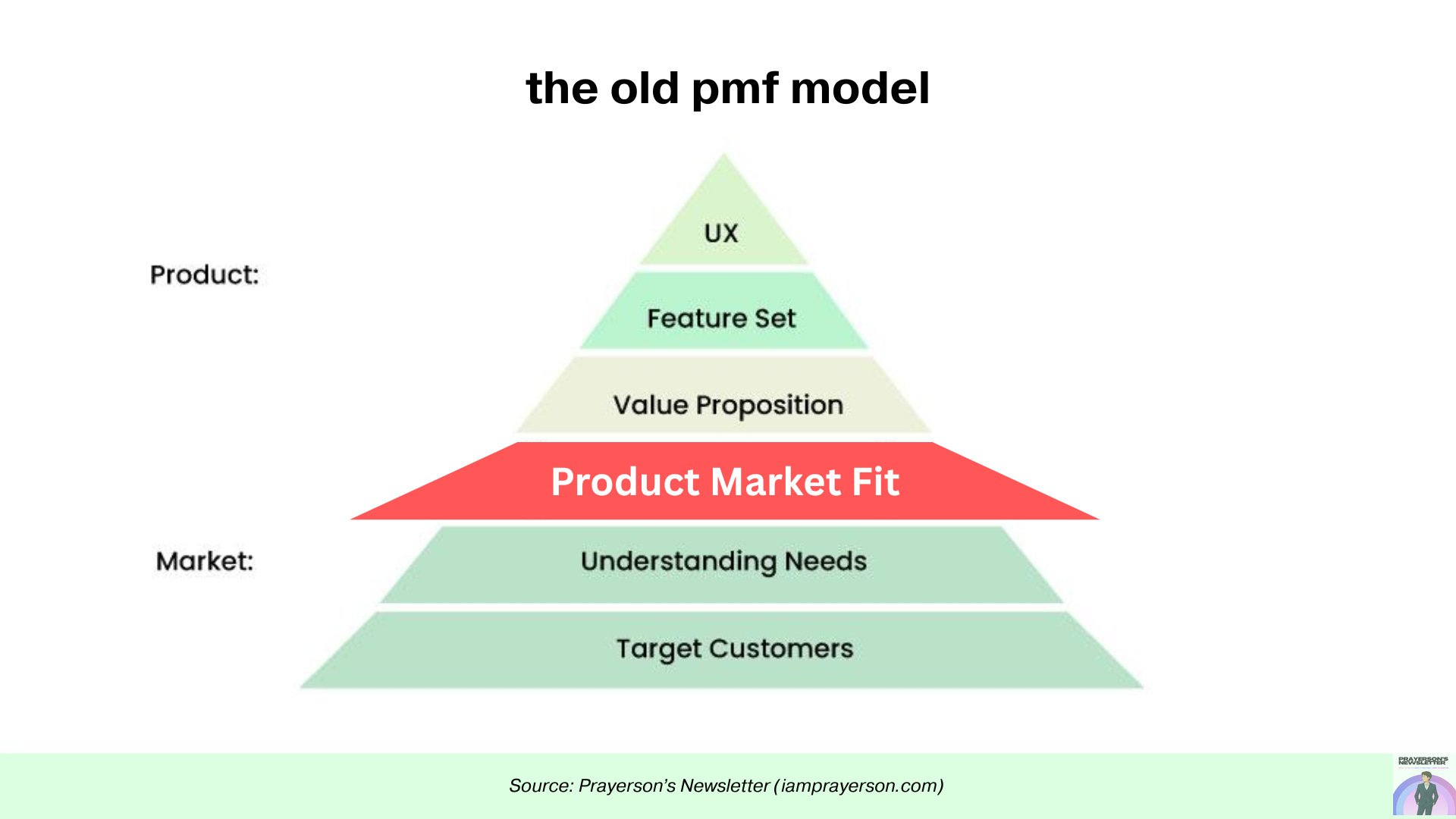
product market fit, as most people learned it, was built on a very specific set of economic and technical constraints. software was expensive to build, slow to ship, and even slower to copy. distribution was hard. attention was limited. if you solved a real problem meaningfully better than anyone else, users tolerated rough edges because the alternative was worse.
that is why early winners could be messy and still dominate. slack was not polished when it started spreading through teams, but nothing else made group communication feel as fluid. dropbox was not beautiful, but it removed the pain of file syncing so completely that people reorganized their work around it. google was not the only search engine, but it was so much better than the rest that switching felt inevitable.
pmf was not mere a viral moment. it was a period of consolidation where one product slowly absorbed a user’s habits while competitors lagged behind. the key ingredient was time. once users invested their workflows, their files, their relationships, and their muscle memory into a tool, leaving it became painful. pmf locked in because the switching cost kept rising as usage deepened.
this entire dynamic depended on the fact that competitors could not instantly copy what you built. differentiation lasted long enough for habits to form.
what ai broke in the pmf equation
ai shattered that timeline. it collapsed the gap between invention and imitation.
today, when a product demonstrates a working workflow, it does not just inspire competitors. it trains them. screenshots become prompts. videos become tutorials. public demos become reference implementations. what took one team months to discover can be reproduced by ten teams in a week.
this has a subtle but devastating effect on pmf. it means that the moment you prove demand, you also invite saturation. users never experience a long period where your product is clearly the best option. instead, they are immediately surrounded by alternatives that are slightly cheaper, slightly faster, or wrapped in a different interface.
in this environment, pmf can no longer be built on features alone. features decay too quickly. novelty evaporates. even model quality converges over time. what does not copy as easily is the way a product fits into someone’s life.
ai accelerated supply far faster than it increased human attention. the result is a market where demand is fragmented across dozens of nearly identical solutions, each fighting for a thin slice of the same cognitive space.
users changed faster than founders realized
there is another shift that most teams underestimate. users themselves have become ai native. they have internalized a different standard of what software should feel like.
chatgpt taught people that asking questions should feel conversational, not mechanical. midjourney taught them that creativity should be immediate, not gated behind tools and training. modern ai tools taught them that their software should remember what they did yesterday and help them continue today.
this changes how people evaluate products. they no longer think in terms of features. they think in terms of responsiveness. does the tool understand what i am trying to do. does it adapt to me. does it make me feel smarter or slower.
a product that would have felt impressive three years ago now feels flat if it does not exhibit some form of contextual intelligence. onboarding flows that ask users to configure everything up front feel archaic. dashboards that require manual exploration feel exhausting. users expect software to meet them halfway.
this is why so many products struggle to reach pmf. they are not competing against their direct category anymore. they are competing against the best experience users have had anywhere on the internet.
pmf used to be about features, now it is about habit gravity
in the ai era, pmf is no longer about what your product can do. it is about what your product becomes.
the products that win are the ones that sit inside repeating moments of human behavior. thinking, writing, communicating, deciding, creating, coordinating. when a tool becomes the place where those activities happen, it accumulates gravity. users stop evaluating alternatives because leaving would mean rebuilding their mental workflow somewhere else.
this is why chatgpt feels so sticky even when it makes mistakes. it is not just a tool for answers. it is a thinking surface. people open it when they are unsure, curious, or stuck. it owns a moment that happens many times a day.
notion did not win because it had good documents. it won because teams built their operating system inside it. leaving notion means losing not just data, but the structure of how work is organized.
midjourney did not win because of image quality alone. it won because people started opening it whenever they wanted to explore ideas visually. it became a creative ritual.
pmf today means you own a loop of behavior. once you own that loop, competitors can clone your features, but they cannot easily displace your role in someone’s routine.
why retention is exposing fake pmf everywhere
one of the strangest side effects of ai is that it made top of funnel look healthy even when the product is hollow.
distribution is no longer the bottleneck. a decent landing page, a few screenshots on x, a launch on product hunt, or a demo video that looks magical is enough to get tens of thousands of people to try something. ai lowered the cost of curiosity to almost zero.
that creates a dangerous illusion for founders and pm’s. the graph goes up. signups come in. demos convert. the team feels validated. but underneath that surface, the real question has not been answered yet: do people come back when nobody is reminding them.
retention is where pmf now either proves itself or collapses.
what most teams see today is a steep drop after the first few sessions. users try the product, get something useful, maybe even have a wow moment, then drift away. not because the product is bad, but because it never became a habit. it never earned a permanent place in their workflow.
ai makes this worse in a very specific way. it makes first use spectacular. the first prompt, the first generated design, the first summary all feel powerful. that initial dopamine masks the fact that there is no reason to come back tomorrow. novelty can look like pmf for weeks.
this is why so many ai tools feel like they are “almost there” forever. they keep adding features, polishing outputs, and shipping new capabilities, but retention never settles. the product keeps getting better, but attachment never forms.
in older software eras, weak pmf showed up early. people never adopted. today, weak pmf shows up late, after the growth party is already over.
the new pmf filter in the ai era
the biggest mistake teams make right now is that they still evaluate pmf the way they did five years ago. they look at growth, they look at conversion, they look at nps, and they look at how often someone uses the product. all of that still matters, but it misses the real question.
the real question is whether your product has become part of someone’s cognitive map of how they get work done.
in the ai era, pmf is not when users say they like your product. pmf is when they forget that alternatives exist.
that happens when four forces line up.
frequency is about how often the underlying problem shows up in a person’s life. not how often they open your app, but how often they encounter the need you serve. tools that sit on daily or weekly needs have more chances to become habits. tools that serve rare or episodic needs have to work much harder to earn a place.
switching pain is about what gets lost when someone leaves. data, history, preferences, workflows, collaborators, and muscle memory all stack into an invisible cost. the longer someone uses a product, the more expensive it becomes to walk away. this is why pmf compounds over time for the winners.
context lock in is about whether your product remembers what matters. when a tool knows what you were doing, why you were doing it, and what you care about, every return feels easier than the last. when it forgets, every session feels like starting over, which quietly pushes people away.
workflow depth is about how much of a real job you own. shallow tools that only touch one small step get replaced easily. deep tools that own the entire flow become structural. users do not just use them. they work inside them.
modern pmf is not about any one of these. it is about all four reinforcing each other. when a product sits on a frequent problem, builds switching pain through data and history, locks in context, and owns a deep workflow, it stops being evaluated and starts being relied on.
case studies, who has it and who is still leaking
chatgpt looks dominant on the surface, but its pmf is more subtle than most people think. it has extreme frequency because thinking, writing, and problem solving happen all day long. it also has growing context lock in as conversation history and memory build up. where it still leaks is workflow depth. many users take what chatgpt gives them and complete the real work somewhere else, in a document, a codebase, or a spreadsheet. that means it owns the thinking moment, but not always the execution. its pmf is real, but it is still evolving.
midjourney owns a narrower slice of life, but it owns it deeply. when someone wants to explore visual ideas, they open midjourney. the prompts, the iterations, and the community all create switching pain and context. you cannot casually recreate that history elsewhere. its pmf is strong because it is the default place for a specific creative loop.
notion is one of the clearest examples of modern pmf. it does not just store documents. it stores how a team thinks. tasks, notes, plans, and decisions all live in one place. the longer a team uses notion, the more their organizational memory becomes entangled with it. leaving would mean rebuilding not just files, but the structure of how work happens. that is what real pmf looks like.

perplexity has a strong value proposition and impressive first use, but it still leaks because it often fails to capture what happens after the answer. people research, get what they need, and move on. unless that research becomes part of a growing body of knowledge that lives inside the product, switching stays easy. pmf remains fragile.
these examples show the same pattern. pmf is not about how impressive a product is. it is about how hard it is to remove from someone’s routine.
how pm’s should search for pmf in 2026
finding pmf now means hunting for loops, not features.
the first thing to map is the real human behavior you are trying to own. not the task your product does, but the moment when someone feels the need for it: frustration, curiosity, planning, coordination, creation. those are the entry points.
then you look for repetition. does this moment happen often enough that someone would benefit from having a default place to go.
next you look for depth. can you own multiple steps of what happens after that moment. can you carry someone from intention to outcome without them leaving.
then you look for memory. can you remember what they did last time so the next time is easier, faster, and more personal.
pmf experiments now look like this: you change one thing that increases repetition, or one thing that increases memory, or one thing that deepens the workflow. then you watch whether people come back without being pushed.
if they do, you are getting closer. if they do not, no amount of new features will save you.
closing reflection
product market fit has not become impossible. it has become unforgiving.
ai removed the cost of building and the cost of copying. what remains scarce is human habit. attention, trust, and routine are the new moats.
the teams that win in this era will not be the ones who ship the most. they will be the ones who quietly become part of how people think and work.
pmf now lives inside behavior. if you understand that, you still have an edge.