
your ai stack is your new product team
how modern teams are being rebuilt around agents, automations, and one pm who knows how to orchestrate them
if you’d rather listen than read, check out the latest episode on “your ai stack is your new product team.”
i’ve been watching a quiet shift unfold across product teams this year. it’s one of those changes you only notice when you sit in enough rooms, listen to enough founders, watch enough sprint boards, and pay attention to how work actually moves.
the language hasn’t changed. org charts still look familiar. titles haven’t been updated. companies still announce new hires the same way. but the work itself, the thing that used to bounce between designers, pm’s, qa testers, analysts, and engineers, is slowly getting pulled into a different center of gravity.
that shift has a name. your ai stack is slowly turning into your product team.
for the first time in more than a decade, the people in the building aren’t the only ones shipping. entire layers of work are getting absorbed by systems that don’t get tired, don’t wait for sync meetings, and don’t lose context between tasks. the real surprise is how fast it’s happening.
if you work in product, this isn’t a cool trend to observe. it’s the architecture you will be working inside for the next decade, whether your company admits it or not.
the invisible re-org already underway
if you talk to enough companies, you notice a pattern. teams aren’t announcing reorgs. they’re just… shrinking. not with layoffs or budget cuts (although those happened too), but with workflow collapse.
qa teams that had five people now have one, mostly because regression tests run through autonomous sweeps. csv audits move through agents instead of analysts. design teams rely on ai-driven review tools to surface ux issues that used to require hours of human scanning. engineers are writing code with copilots that generate scaffolding, documentation, and test suites before the first commit even hits trunk.
stripe talked about this openly on a podcast earlier this year, how internal tooling amplified the output of small teams far beyond what headcount suggested. meta has publicly acknowledged internal ai systems accelerating ux reviews and content audits. even mid-stage startups are running with configurations that would’ve looked irresponsible in 2019: one pm, one designer, two engineers, and a pile of agents stitched across every stage of the lifecycle.
the most interesting part is that none of this is branded as a “transformation.” it’s happening naturally because the economics support it. the work is changing shape, and teams follow the work.
what that means, practically, is simple: your job as a pm isn’t disappearing, but the surface area under you is expanding in a way that would’ve been impossible a few years ago.
the ai stack and the roles it quietly absorbs
to understand why the shift feels bigger than “ai tools,” you need to look at what actually gets replaced, absorbed, or blended into the stack.
the research layer
traditionally: handled by researchers and analysts
now: perplexity workflows, agentic multi-tab research, internal knowledge copilots
companies report that manual research time is down by 60–80 percent for many teams because agents synthesize cross-site information faster than humans can open tabs.
the design and ux layer
traditionally: competitive analysis, user flows, heuristic reviews
now: ai-driven flow audits, component suggestions, competitor breakdowns pulled directly from public interfaces
tools are catching up to the point where early design work feels more like reviewing than creating.
the engineering layer
traditionally: scaffolding, test writing, debugging, documentation
now: ai copilots generate structure, propose architecture, write tests, and catch bugs before engineers do
cursor’s multi-agent debugging demos are a clear example of how fast this is moving.
the qa layer
traditionally: regression sweeps, test plans, cross-device reporting
now: autonomous sweeps that run continuously, not quarterly
teams at mid-stage saas companies report a 3–5x reduction in manual qa effort since adopting ai-assisted testing.
the growth and content layer
traditionally: lifecycle flows, content, seo experiments
now: agents generate and optimize lifecycle sequences, evaluate funnel drop-offs, and rebuild copy instantly
the shift here is dramatic enough that many marketing teams run experiments weekly instead of quarterly.
each of these layers used to be a job. now they are capabilities inside the ai stack.
that doesn’t diminish the need for humans, but increases the need for someone who can hold the system together.
what the pm becomes in an ai-stacked team
pm’s used to spend half their time coordinating people and the other half filling the gaps between functions. that era is ending (almost there).
the pm who survives this shift understands how work flows through systems, and not schedule meetings or coordinate between teams. instead of asking “who should do this?” the pm now asks “what should handle this?”
ai isn’t replacing the pm, but it’s removing the places where average pm’s used to hide. for example the busywork, the documentation, the glue that no one wants to do but everyone depends on.
the pm now becomes a systems owner:
designing workflows that combine agents and humans
maintaining context across long-running tasks
identifying where automation breaks
shaping the logic and behavior of internal agents
measuring output in terms of leverage, not activity
andrew ng (co-founder of coursera) said something that has stuck with me:
“ai is the new electricity”
it’s blunt, but it’s exactly what’s happening across orgs.
how the product team itself is changing
the classic pod model of one pm, one designer, four engineers, one analyst, and one researcher is slipping into the rearview.
teams that adopt ai as a core layer look more like this:
the new ai-native pod:
one pm
one or two engineers
ai research systems
ai design audit tools
ai qa systems
ai content and growth agents
a lightweight analytics stack powered by model-driven insights
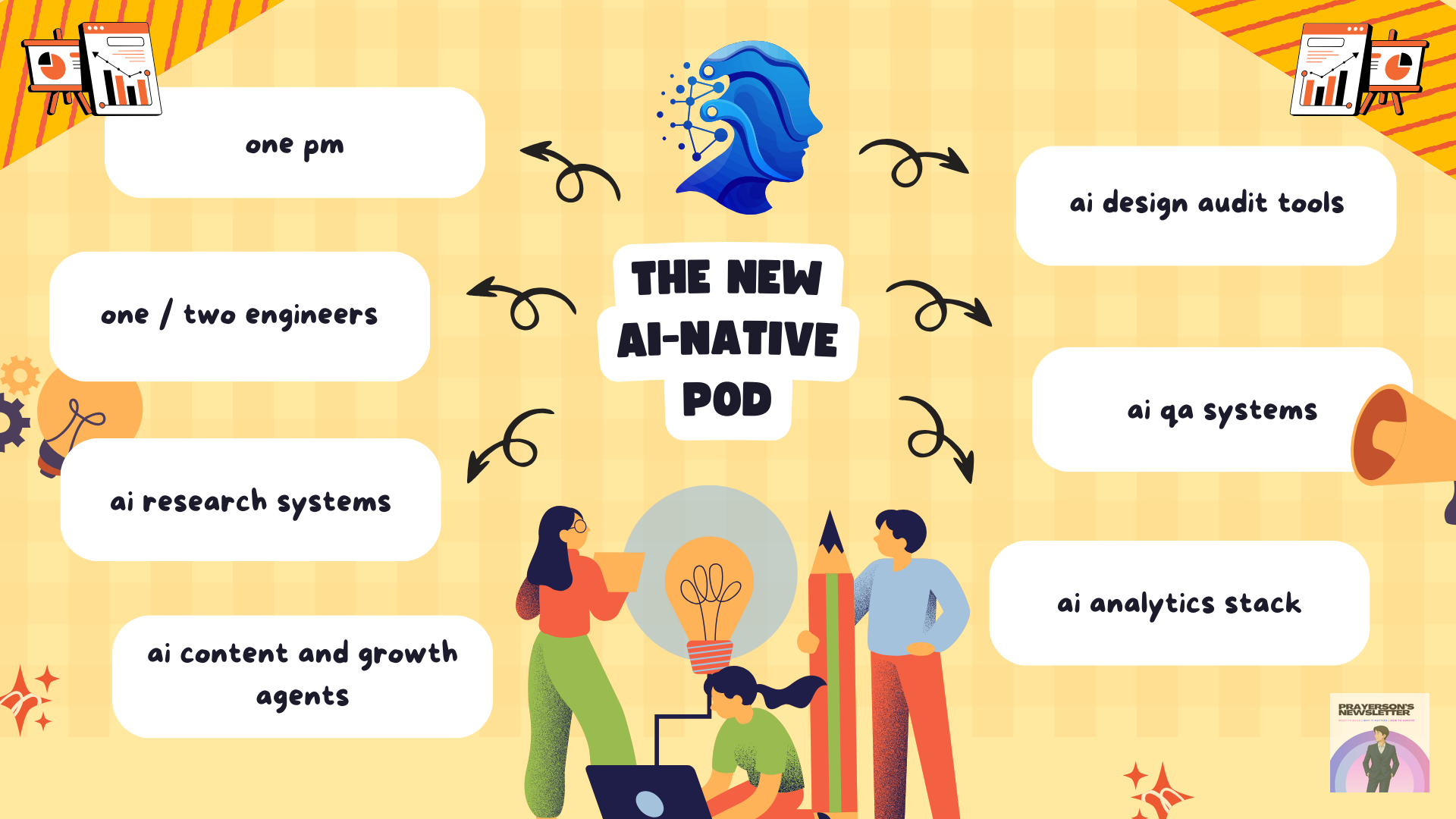
the surprise isn’t that this works, but that it works better than the old model for a huge percentage of product teams. the ai pm today sits in the middle not as a manager, but as the operator of a system with both human and non-human components. this shift is why you’re seeing org ratios move from one pm per four or five engineers to one pm per eight or ten, without quality dropping.
the skills a pm needs to actually run an ai-first team
if you want to become a product manager in the ai era, or if you’re an existing pm and want to survive this shift (and more importantly, benefit from it), you need to rewrite your skill stack.
you don’t need to code at a senior level, but you need to understand the shape of the code. you don’t need to fine-tune a model, but you need to understand how models interpret instructions, how they break, and how to debug decisions.
here are the practical skills that matter:
ai fluency
understanding prompt behavior, model drift, failure modes, grounding, context windows, and evaluation patterns
workflow design
knowing how to chain tools, agents, and human input in a way that feels natural and doesn’t fall apart under load
system-level thinking
the ability to maintain a mental map of what happens before, during, and after an agent runs
writing for agents
clear, structured instructions that act as micro-specs for workflows
data comfort
reading dashboards, understanding where data breaks, and catching anomalies without someone spoon-feeding insights
product intuition
this one hasn’t changed, but the bar is rising because the execution layer got easier, making judgment the real differentiator
the pm who learns these skills feels bigger than their headcount. the pm who doesn’t feels smaller every quarter.
what breaks when everything runs through ai
agents are powerful, but they’re brittle in their own ways. if you stitch everything together without thinking, you’ll end up with a workflow that feels impressive on a whiteboard and completely unmanageable in the real world.
the biggest failures come from:
hallucinated data inside long workflows
permissions or privacy mismatches
silent agent failures that go unnoticed
over-automation that hides important context
model drift that ruins reliability
missing human checkpoints for irreversible actions
this ties into what we explored earlier in ai and the ethics of product management. the risk today isn’t capability, but governance. the pm becomes the governance layer by default, because someone has to own it, and who’s a better owner than a pm?
how to build a 2026-ready ai stack
here’s the part people actually need. the stack that works in practice today.
research
multi-agent analysis tools
internal knowledge copilots
design
ai-driven flow audits
quick competitor breakdowns
ux issue detection systems
engineering
interpretability tools
automated test writing and debugging
qa
agent-based regression sweeps
scriptless testing platforms
cross-device monitoring agents
growth
lifecycle agents
content generation tuned with guardrails
ai-driven funnel analysis
analytics
model-assisted insights
anomaly detection
cohort pattern recognition
you don’t need all of these on day one. you need the parts that give you back the most time and remove the most friction from your team. the pm’s who grow fastest in this era will be the ones who build the stack early and refine it constantly.
closing reflection
the biggest misunderstanding about ai in product management is the fear that jobs disappear. the reality is more uncomfortable and more interesting: the job doesn’t disappear, but the shape of the job changes so much that you can’t rely on the old instincts anymore.
your ai stack will not just be another list of tools, but it’s the team that stands behind you when you walk into a sprint review. it’s the support system that carries the work while you focus on direction. it’s the execution engine that removes the excuses you could once hide behind.
pm’s who embrace this shift will feel like they’ve unlocked leverage they didn’t know existed. pm’s who ignore it will feel like every quarter is slipping out of their hands.
the future doesn’t belong to the pm who “knows ai.” it belongs to the pm who builds with it every single day.
Exceptional articulation of the structural shift happening beneath surface-level org charts. Your point about PMs transitioning from people coordinators to systems owners captures the fundamental redefinition of the role. The breakdown of functional layers being absorbed into the AI stack is precise, particularly the QA example showing 3-5x reduction in manual effort. What stands out is your observation that average PMs no longer have places to hide behind busywork and documentation, which means the bar for core product judgment rises significantly. The workflow collapse pattern you describe at Stripe and Meta isn't being discussed widely enough in PM circles.One nuance worth adding: the governance layer you mention becomes even more critical when agents start making decisions in high-stakes domains like finance or healthcare, where silent falures can create regulatory exposure.